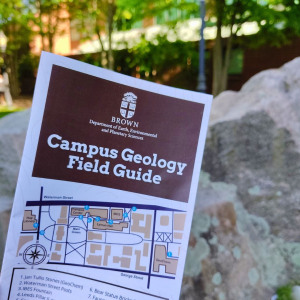
2026 Family Weekend Tours
This Family Weekend, join student representatives from the Department of Earth, Environmental and Planetary Sciences on a special geological tour of College Hill. Space is limited, sign up now to reserve your spot!
The new Campus Geology Field Guide invites users to explore Brown University's campus through a geological lens by learning basic rock types, uncovering campus history, or diving deeper into mineral identification. This free resource was organized by DEEPS graduate students Hannah Shabtian and Emily Fischer, and researched by their Brown Pre-College course as a hands-on exploration of geology and science communication.
This Family Weekend, join student representatives from the Department of Earth, Environmental and Planetary Sciences on a special geological tour of College Hill. Space is limited, sign up now to reserve your spot!
Explore Brown’s campus from a ground-breaking perspective! Created by DEEPS students, this field guide walks readers through some of the unique and striking rock types at some of the most well-known Brown landmarks.
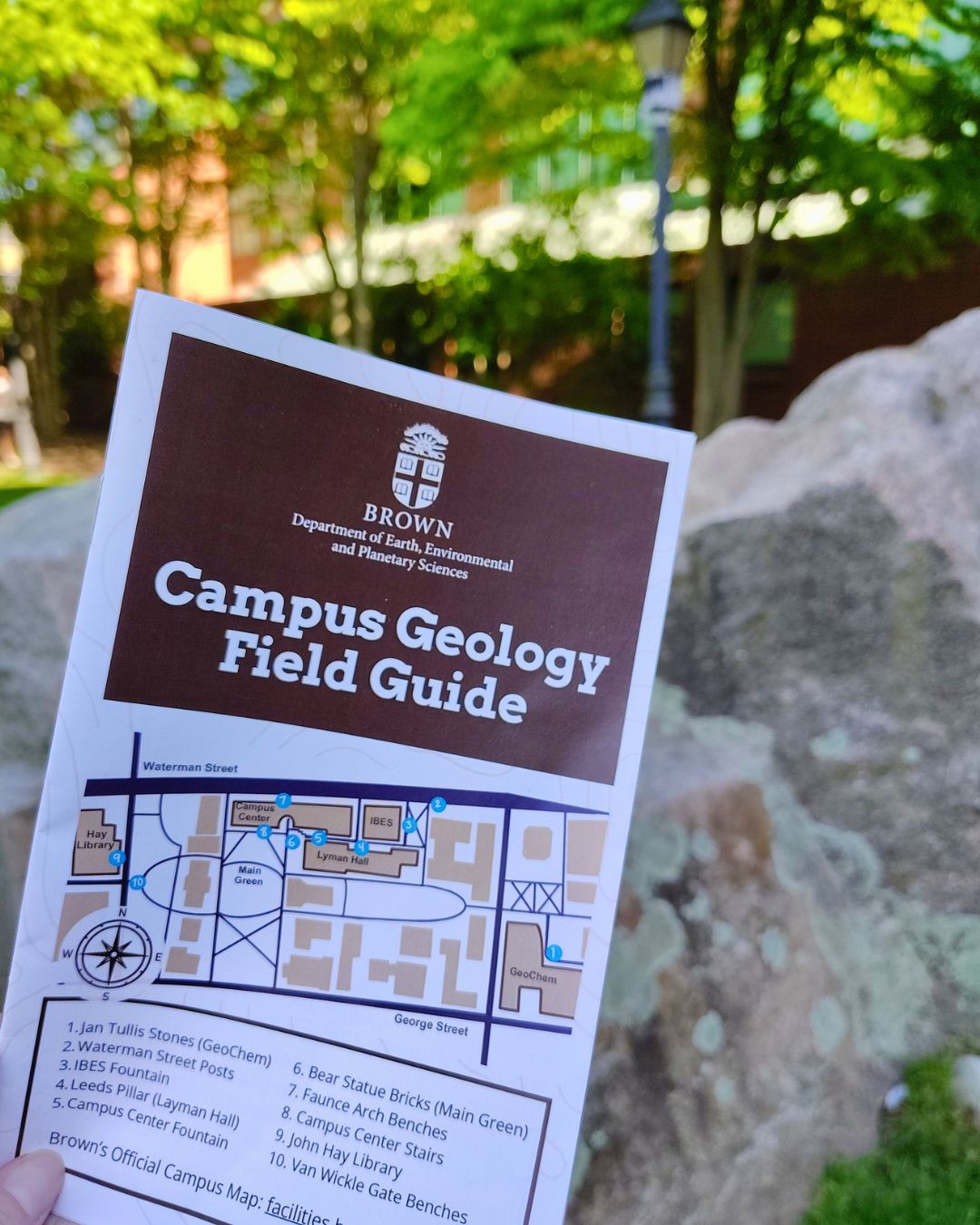 DEEPS graduate students Hannah Shabtian and Emily Fischer were planning their Brown Pre-College course “Thinking Deep: The Geologist Perspective,” and sought a final project that would engage students in hands-on exploration while producing something meaningful beyond the classroom. They envisioned a project in which students could look at real rocks and explore campus, but also create a resource that could be used by prospective and current students, faculty, and visitors. The idea, suggested by DEEPS Communications Specialist Mae Jackson, was to develop a geology guide that could serve as outreach material and spark broader interest in Earth science. The result was the Campus Geology Field Guide.
“If you have never really thought about rocks before, you can use this guide to learn a bit of campus history, the basic rock types, and discover where to find them on campus.” says Hannah. “Ultimately, the goal is to have fun, explore campus through a new perspective, and learn a little bit more about the world around us.”
The project was strongly influenced by Hannah and Emily’s own undergraduate fieldwork experiences, which emphasized the importance of hands-on, investigative learning. Wanting to recreate that sense of excitement, the course included an active field component. The guide offered students a valuable opportunity to practice science communication, an essential skill for young scientists. Students were asked to write for a science-interested general public, requiring them to adapt technical knowledge into accessible language.
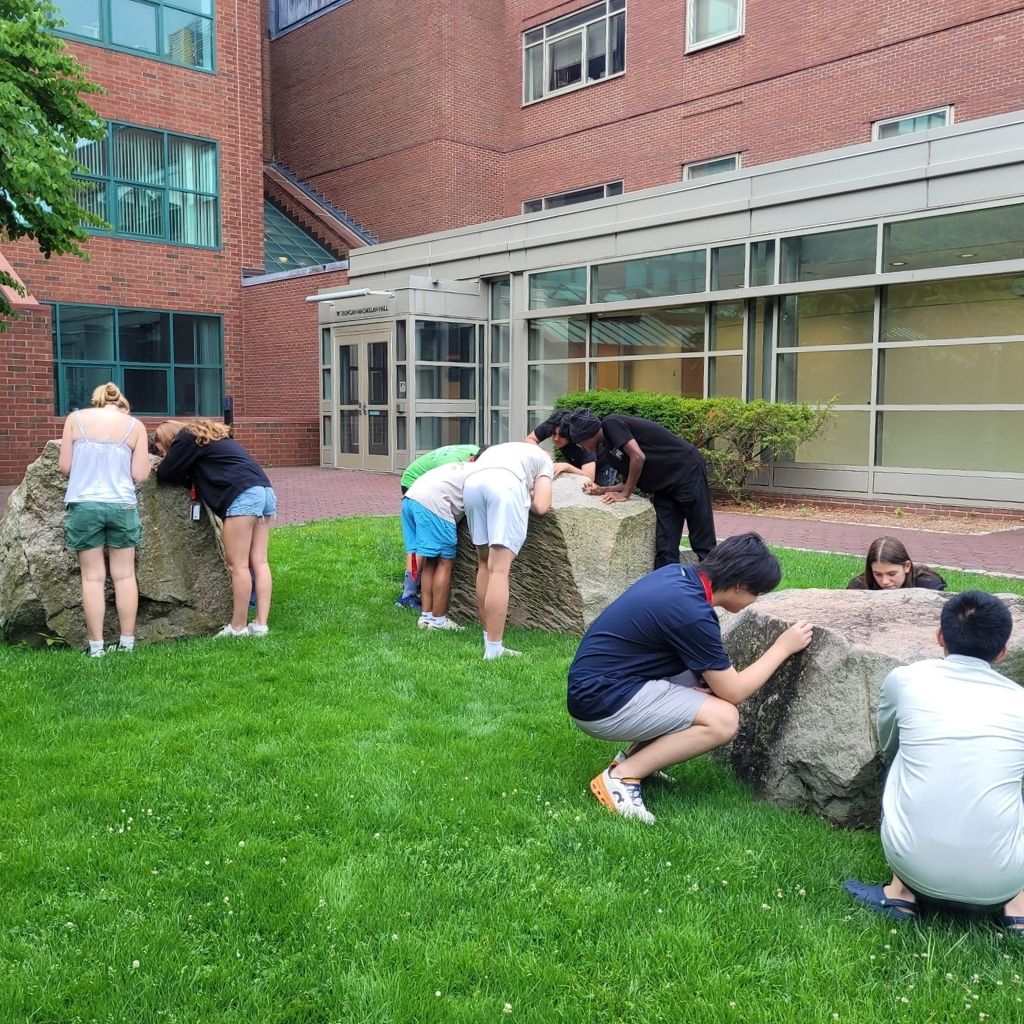 Preparation for the guide involved extensive groundwork. Before the course began, Hannah and Emily surveyed campus multiple times, pinpointing locations with interesting geological features–for example, buildings made of distinctive stone or sidewalks with visible crystals. They made preliminary observations and classifications to guide students during the project.
The Pre-College students then took the lead in research. Working in groups, they were assigned several campus locations and tasked with identifying and describing the geology, including rock types, formation processes, and evidence supporting their conclusions. They were also encouraged to uncover “fun facts,” such as the origins of specific rocks or how they came to campus, which added an engaging historical dimension.
The final stage involved synthesizing student work into a cohesive guide. Mae Jackson played a key role in assembling and refining the material, as the team worked to distill detailed research into a format suitable for a broad audience. The resulting guide invites users of any background to explore campus through a geological lens by learning basic rock types, uncovering campus history, or diving deeper into mineral identification.
“If you do use the field guide, take a picture and tag the DEEPS Instagram!" asks Emily. "We want to see what people are learning!”